Engineering Note
Why Aluminum Shaft Clamps Fit Lightweight Automation
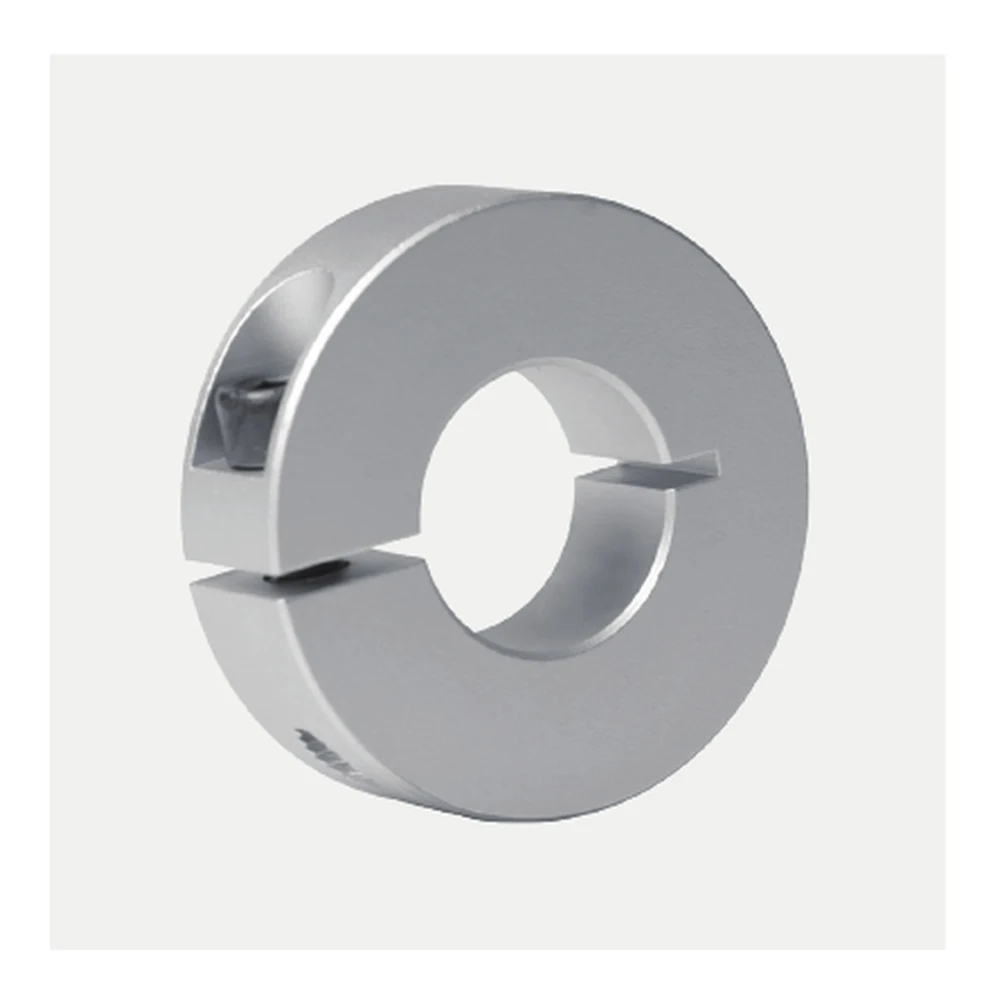
Aluminum shaft clamps are attractive in lightweight automation because they can provide an axial reference without adding a large steel component to a compact fixture or motion assembly. The material choice is only one part of the decision, however; the shaft fit, envelope and application duty still control whether the collar is appropriate.
The EP-SCS family combines an aluminum body with a single-split clamping format across 6–60 mm metric bores. For compact automation, the smaller and middle sizes are especially useful to evaluate when a removable stop or setup locator is required.
Why Low Mass Can Help
Compact automation often concentrates many components around a small moving or semi-moving structure. Keeping a simple locating part light can help reduce unnecessary mass and make assembly handling easier, especially on fixtures, test rigs and small mechanisms.
That does not mean every lightweight system should use the smallest possible collar. Outside diameter, width and screw access still need to fit the machine, and the collar’s intended duty should be stated separately from the material.
Clamp-Style Contact and Repositioning
The single-split format closes around the shaft rather than relying on one set screw pressing into the surface. This is useful when a setup position may be changed during commissioning or maintenance and the installer wants to avoid repeated point contact at different shaft locations.
Repositioning should be done with the clamp loosened sufficiently and the contact surfaces clean. A clamp collar is easier to adjust when service access was planned before surrounding brackets and guards were installed.
Compact Envelopes Need More Than Bore Selection
Small automation mechanisms can be very sensitive to the collar outside diameter. A correct bore can still create interference with a carriage, sensor, cable route, frame extrusion or bearing block.
Check the full travel path and reserve tool access for the clamp screw. In many compact assemblies, those two checks are more important to successful installation than the difference between neighboring bore sizes.
Typical Lightweight-Automation Uses
| Use | What to Check |
|---|---|
| Guide-shaft stop | Carriage travel, contact condition and end-of-stroke clearance. |
| Fixture reference | Adjustment frequency and tool access. |
| Prototype/test rig | Ability to reposition without conflicting with temporary hardware. |
| Small motor/drive assembly | Clearance from couplings, pulleys and motor faces. |
Material and Environment Questions
If the application has washdown, corrosion, high temperature or a specific finish requirement, include that information in the RFQ. The word “aluminum” alone does not define every environmental or documentation requirement a buyer may have.
Likewise, application-critical properties such as tightening torque or axial holding demand should be confirmed for the ordered configuration rather than inferred from the material name.
Selection Path
Measure the shaft, shortlist the matching EP-SCS bore, compare OD/width with the compact envelope and check the screw orientation. Add a drawing or photo when the machine is densely packed or the collar sits inside a moving assembly.